I am wearing a silver hoodie that stops just below the nipples. Or, if you prefer, a baggy crop-top with a hood. The piece – this is fashion, so it has to be a "piece" – is one of a kind, a prototype. It has wide square shoulders and an overzealous zip that does up right to the tip of my nose.
It does not, it's fair to say, make its wearer look especially cool. But that's not really what this hoodie is about. It has been designed to hide me from the thermal imaging systems of unmanned aerial surveillancevehicles – drones. And, as far as I can tell, it's working well.
"It's what I call anti-drone," explains designer Adam Harvey. "That's the sentiment. The material in the anti-drone clothing is made of silver, which is reflective to heat and makes the wearer invisible to thermal imaging."
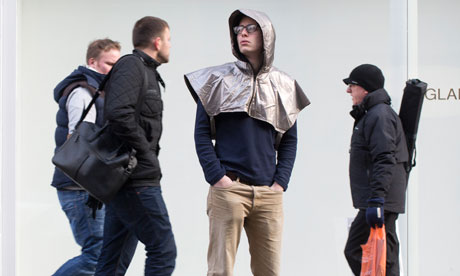
The "anti-drone hoodie" was the central attraction of Harvey's Stealth Wear exhibition, which opened in central London in January, billed as a showcase for "counter-surveillance fashions". It is a field Harvey has been pioneering for three years now, making headlines in the tech community along the way.
It began in 2010 with Camoflash, an anti-paparazzi handbag that responds to the unwanted camera flashes with a counter-flash of its own, replacing the photograph's intended subject with a fuzzy orb of bright white light.
Then came his thesis project CV Dazzle, a mix of bold makeup and hairstyling based on military camouflage techniques, designed to flummox computer face-recognition software. It worked, but also made you look like a cyberpunk with a face-painting addiction. Which was not exactly inconspicuous.

No comments:
Post a Comment